Pensions and Inheritance Tax: What Changes in April 2027 — and What to Do Before Then

From 6 April 2027, most unused pension funds will be pulled into the taxable estate for the first time. It's the most significant shift in estate planning practice in a generation — here's what's actually changing, and the steps worth taking now.
For as long as most of our clients have been saving into a pension, the pension pot has sat outside their estate for Inheritance Tax purposes. That has made pensions one of the most efficient wealth transfer tools available — draw down other assets in retirement, leave the pension untouched, and pass it to the next generation free of IHT.
That era ends on 6 April 2027. Following Finance Act 2026 (Royal Assent 18 March 2026), most unused pension funds and pension death benefits will be brought within the value of the deceased's estate for IHT purposes. HMRC published its technical note on how the regime will work in practice on 11 May 2026, and the direction of travel is now settled — this is no longer a proposal under consultation, it is confirmed law due to take effect for deaths on or after that date.
-
6 Apr 2027
Effective date — applies to deaths on or after this date, regardless of when the pension was built up
-
~8%
Estates HMRC estimates will be affected each year
-
40%
Rate at which pension value will be taxed once it falls into the estate, above available nil-rate bands
01. What Is Actually Changing
Currently, most defined contribution pension pots fall outside the estate because scheme trustees or administrators retain discretion over who receives the death benefit. From April 2027, that discretion no longer determines the IHT treatment. The value of "unused pension funds" and pension death benefits — what the legislation terms notional pension property — will be added to the deceased's estate and taxed at the standard 40% rate above the available nil-rate band.
This applies whether the member dies before or after age 75, and regardless of whether the funds are uncrystallised, in drawdown, or otherwise undrawn. It is a change to the IHT treatment of the pension pot itself, sitting alongside — not instead of — the existing income tax treatment of death benefits paid to beneficiaries.
What remains exempt
- Spousal and civil partner transfers — the spouse exemption continues to apply to pension death benefits passing to a surviving spouse or civil partner, exactly as it does for other estate assets.
- Death-in-service benefits paid from registered occupational schemes.
- Dependants' scheme pensions.
- Charitable lump sum death benefits — and estates leaving 10% or more of the net estate to charity continue to benefit from the reduced 36% rate where applicable.
The point most clients miss: this is not a change to income tax on pension death benefits (the existing rules on tax-free payment before age 75, and marginal-rate taxation after 75, continue to apply in parallel). It is a new and separate IHT charge sitting on top. Where both apply, the combined effective rate on a pension passing to a non-exempt beneficiary can be very significant — this is the calculation clients need to see in front of them, not just the headline 40%.
02. What Clients Should Be Doing Now
- Revisit the "spend other assets first, leave the pension untouched" drawdown strategy. This has been standard advice for a decade. From April 2027 it no longer delivers an automatic IHT saving, and for some clients the opposite may now be true — it may be more efficient to draw down the pension during lifetime (subject to income tax) and gift or spend the proceeds, rather than preserve it as a "tax-free" legacy that no longer is one.
- Update expressions of wishes / nomination forms now, and keep them under regular review. Scheme discretion still determines who receives the benefit even though it no longer determines whether IHT applies — an out-of-date nomination remains a real risk in its own right.
-
Understand that two separate taxes can now apply to the same pension pot — not just one.
This is the part that catches most people out, so it's worth spelling out plainly. When you die, your pension has always been subject to income tax in the hands of whoever inherits it — tax-free if you die before age 75, or taxed at their own marginal rate (20%, 40% or 45%) if you die at 75 or over. That rule doesn't change.
What changes from April 2027 is that before that income tax is even worked out, the value of the pension will first be added into your estate and potentially charged to Inheritance Tax at 40% — the same as your house, savings, and everything else you own. So for anyone who dies at 75 or older, leaving a pension to someone other than a spouse (an adult child, for example), the pension could effectively be taxed twice: once by Inheritance Tax on the way into the estate, and again by income tax on the way out to the beneficiary.
A simplified example: say you die at 78 with a £400,000 pension pot, no spouse to leave it to, and your Inheritance Tax nil-rate bands are already used up by other assets. Inheritance Tax at 40% could take £160,000 of that straight away. Your child then receives the remaining £240,000 as pension income and, if they're a higher-rate taxpayer, could pay 40% income tax on top — a further £96,000. Out of an original £400,000 pot, as little as £144,000 might ultimately reach them. Every family's figures will differ, but the principle is the same: the combined effect of both taxes together, not the 40% IHT rate in isolation, is the number that actually matters — and it's the number we model for you.
- Ensure your will and letter of wishes are consistent with how you now expect the pension to be treated — including whether personal representatives will need liquid funds elsewhere in the estate to meet a tax liability that a pension can no longer quietly absorb.
The practical choices in front of you
Beyond reviewing your paperwork, there are several concrete things you can actually do with your pension and wider assets to reduce the impact. None of them will suit every client, and most work best in combination — this is precisely the kind of planning that needs to be modelled against your own figures rather than applied as a generic rule.
- Draw down more of your pension during your lifetime, rather than leaving it untouched. Because the pension no longer escapes Inheritance Tax by simply being left unspent, there is far less benefit in preserving it "for later" and living off other savings instead. For many clients, the better approach going forward will be to draw a sustainable income from the pension in retirement, spend or gift that income, and let non-pension assets — which have always been fully within your estate anyway — reduce naturally through ordinary spending instead. This flips the conventional order of drawdown many clients have followed for the past decade.
- Consider an annuity for some or all of your pension pot. Once a pension is converted into a lifetime annuity, it becomes an income stream rather than a capital sum — there is no remaining "unused fund" left to fall into your estate on death (aside from any guaranteed payment period still running). For clients who want certainty and simplicity over flexibility, an annuity can sidestep the new rules altogether, though this needs to be weighed carefully against the loss of flexibility, and the fact that annuity income itself may leave you with more surplus income to gift (see below) or more of an income tax bill to manage.
- Make regular gifts out of surplus income. If, after drawing your pension, you have income left over after meeting your normal living costs, you can gift that surplus away — immediately and completely free of Inheritance Tax — provided the gifts are regular, come from income rather than capital, and don't reduce your own standard of living. This is one of the most under-used reliefs in estate planning, and unlike most other gifts, there's no need to survive seven years for it to work. For a client now drawing more pension income specifically to spend it down (see above), this can be paired directly with regular gifting to children or grandchildren.
- Review whether a trust has a role to play. Trusts won't shelter pension death benefits from the new charge in the way "spousal bypass trusts" were sometimes used in the past, but they remain a valuable tool for controlling how and when the next generation receives wealth, protecting assets for young or vulnerable beneficiaries, and making full use of your Inheritance Tax nil-rate band during your lifetime through a lifetime trust gift. Existing bypass trust arrangements set up under the old rules should be reviewed now, as some may need restructuring to remain effective.
- Make one-off lifetime gifts (PETs) while you're in good health. Larger gifts of capital — whether from pension drawdown, other savings, or investments — fall outside your estate entirely if you survive seven years, with taper relief reducing the tax charge from year three onward if you don't. With less scope to rely on the pension as a passive IHT shelter, lifetime gifting of this kind is likely to play a bigger role in most clients' planning than it has in the past.
None of this needs to wait until 2027. The rules already apply to deaths on or after 6 April 2027, but the planning window is now — nominations, gifting strategies, and drawdown patterns put in place today shape the position your estate will be in when the rules bite.
03. The Knock-On Effects: The Residence Nil-Rate Band and the 36% Charity Rate
Bringing pensions into the estate doesn't just create a new charge on the pension itself — it also changes the maths on two reliefs that many clients already rely on, simply by making the estate look larger on paper.
The £2m taper on the Residence Nil-Rate Band
The Residence Nil-Rate Band (RNRB) — currently worth up to £175,000 per person on top of the standard £325,000 nil-rate band — starts to be withdrawn once an estate exceeds £2 million, reducing by £1 for every £2 over that threshold until it disappears entirely at around £2.35 million. Crucially, that £2 million test is based on the value of your whole estate — and from April 2027, your pension value will, for the first time, be counted within it.
This means clients who have never previously come close to the £2 million taper — because their houses, savings and investments alone sat comfortably below it — may find that adding in the value of a pension pot built up over a working lifetime tips them over the threshold, quietly losing some or all of a valuable relief they've always been able to rely on. This is likely to catch out a meaningful number of otherwise moderate estates, and is a strong reason to model your position now rather than assuming the RNRB will simply apply as it always has.
The 36% reduced rate for charitable giving
Estates that leave at least 10% of their "net estate" to charity qualify for a reduced Inheritance Tax rate of 36%, rather than the standard 40%, on the remainder. That 10% test is calculated against the net value of the estate after reliefs and exemptions — and once pension value is included in the estate from April 2027, it will also be included in that calculation. For clients who have structured (or are considering) charitable legacies to reach the 36% rate, the sums involved will need to be reworked once pension value is added to the pot — the same percentage gift may no longer clear the 10% threshold, or a larger legacy than previously planned may now be needed to do so.
The common thread: almost every part of Inheritance Tax planning that used to treat pensions as "outside the estate" now needs to be re-run with pensions counted in. That includes RNRB taper, the 36% charity rate, and the balance between lifetime gifting and assets left on death. This is exactly why more lifetime planning — not less — is now needed, and why a plan built around your actual numbers matters more than general guidance.
04. How Executors and Pension Scheme Trustees Will Need to Work Together
One of the most practical consequences of the reform is procedural: personal representatives (PRs) and pension scheme administrators will need to exchange information and, in some cases, coordinate payment of the tax — a relationship that, for most estates, simply didn't exist before. HMRC's technical note sets out a broad five-stage process. It looks like this in practice:
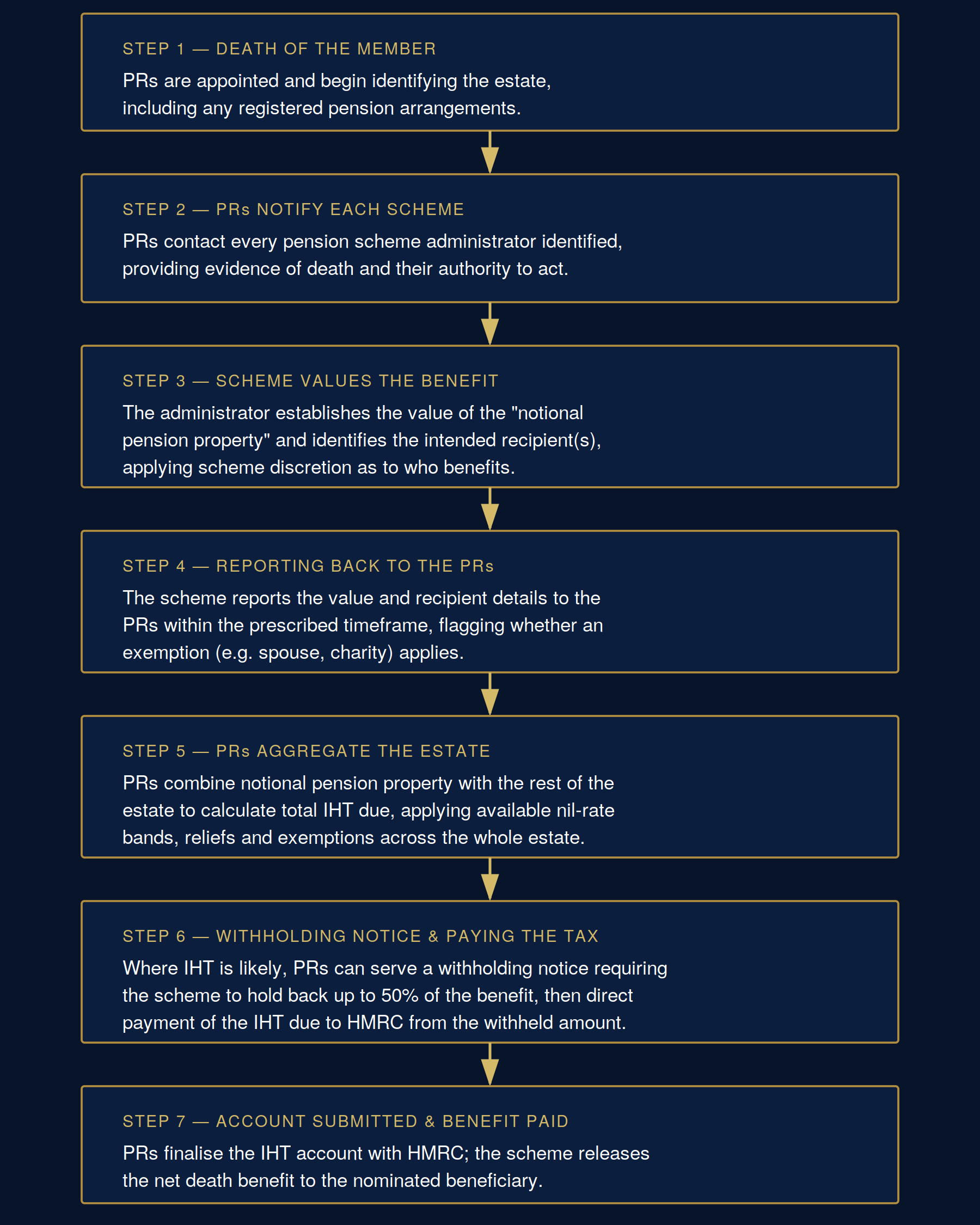
Based on HMRC's technical note on Inheritance Tax on Pensions (11 May 2026) and Finance Act 2026. Scheme-level timeframes and reporting templates are still being finalised ahead of April 2027 — this reflects the process HMRC has indicated it is working towards.
The practical burden this creates for PRs shouldn't be underestimated. Where a member held pensions with several providers, PRs will need to track each one down, request valuations, and wait for each scheme's response before the full IHT position can be finalised — all within the existing statutory timeframes for reporting and paying IHT. Executors administering an estate with multiple pension arrangements should expect this to add real time to the process, and should budget for it when giving beneficiaries an indication of how long administration will take.
The withholding notice: a new power for PRs
One of the most significant practical tools introduced alongside the reform is the withholding notice, provided for under a new section 226A of the Inheritance Tax Act 1984. It exists to solve an obvious problem: PRs are now responsible for reporting and paying IHT on notional pension property, but the pension itself sits with a third-party scheme administrator, not the PR — so how does the PR make sure the money is still there to pay the tax once it's calculated?
The answer is that a PR (or, where there's no grant yet, a prospective PR) can serve a formal withholding notice on the pension scheme administrator, requiring it to hold back up to 50% of a beneficiary's entitlement for up to 15 months after the end of the month of death. This overrides the scheme's own rules on paying out promptly, and the administrator has no discretion to refuse a validly issued notice.
It's a targeted power, not a routine step. HMRC's technical note is explicit that withholding is intended for the minority of estates where the PR knows, or has reasonable grounds to believe, that IHT will actually be due on the pension — not as a precautionary default applied to every estate. It can be issued at any point in the 15-month window running from the end of the month in which the member died, giving PRs flexibility to serve it once the position becomes clear, rather than immediately at the outset.
Scheme administrators must acknowledge a valid notice within 14 days, and — once acknowledged — cannot pay out more than the remaining 50% of the entitlement to the beneficiary until the notice is lifted or the tax position is resolved. Exempt beneficiaries fall outside it entirely: amounts due to a surviving spouse or civil partner, a charity, or a registered club can still be paid in full, and the notice only bites on the portion going to non-exempt beneficiaries such as adult children.
The withheld 50% can then be used to settle the IHT. Once the liability is agreed with HMRC, the PR can direct the scheme to pay the tax due directly from the withheld amount — via the linked Pensions Direct Payment Scheme mechanism — with any balance released to the beneficiary once the position is settled. And there are real teeth behind it: a scheme administrator that pays out in breach of a valid withholding notice can become directly liable to HMRC for the resulting shortfall, so scheme administrators will need robust processes to check for a notice before releasing funds.
Why this matters for families: in practice, this means a beneficiary — say, an adult child inheriting alongside an exempt surviving spouse — may only receive half of their pension entitlement immediately, with the remainder held back for up to 15 months while the wider estate's IHT position is finalised. This is a real cash-flow issue worth preparing beneficiaries for now, not a surprise to spring on them after a death.
Speak to us before April 2027
If you hold a pension you've been treating as a way to pass wealth to the next generation free of Inheritance Tax, the position is changing — and the planning window is now, not 2027. We can review your drawdown strategy, nominations, and wider estate plan together, so your pension continues to do the job you intended it to.
For a fixed cost of £3,600 inclusive of VAT, Culver Law will review your full circumstances — your pension arrangements, wider estate, and existing will and nominations — and provide you with a clear, actionable plan tailored to your position. For clients with larger or more complex pension holdings, the tax saved through the right plan can run into the hundreds of thousands of pounds.
Book your pension & estate review
This article is provided for general information only and does not constitute legal or financial advice. The rules described are based on Finance Act 2026 and HMRC's technical note published 11 May 2026, and remain subject to further guidance ahead of implementation on 6 April 2027. You should seek advice tailored to your own circumstances before taking any action. Culver Law Ltd, Hamilton House, 1 Temple Avenue, London EC4Y 0HA. SRA No: 820401.
More articles

T: 0207 846 5029
E: This email address is being protected from spambots. You need JavaScript enabled to view it.
Authorised and Regulated by the Solicitors Regulation Authority. SRA Number: 820401.
Registered Office
22 Tudor Street, London
EC4Y 0AY
Company No. 13313009
Culver Law, London
22 Tudor Street, London, EC4Y 0AY
0207 846 5029
Culver Law, Cambridge
9 Hills Road, Cambridge, CB2 1GE
01223 653010
Culver Law, St Albans
Fountain Court, 2 Victoria Square, Regus
St Albans, AL1 3TF
01727 322988


